


Come to Israel

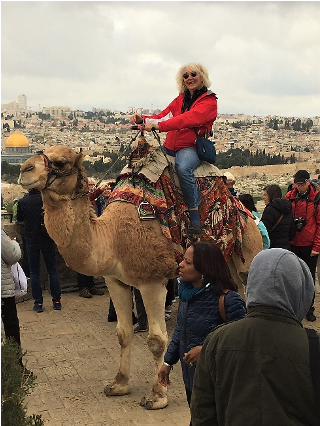
After our long walk back down the hill, we boarded the bus again and drove to a spot overlooking the city. Here a man with a camel was giving camel rides to tourists. Leo had promised us a treat – but this sure didn’t look easy! You had to use a stool to climb up onto a high wall (circular, with a tree in the middle) and then throw your leg over the seat of the camel to get on top. Then, ready or not, he stood up!
We were all kind of holding back, so Father Turner went first – and made it look easy – and fun! In the picture I took, you can see all of Jerusalem behind him. After that, there was a line to get on the camel, even though most of us barely hung on as the camel stood up!

Some went solo, like my friend Sheila and I…

Some went double…
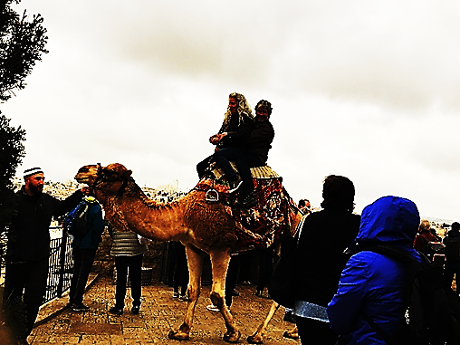

Some gave the camel a little thank you pat… and some stood far away, taking pictures!
After the camel rides, we walked down to the base of the Mount of Olives, to the oldest Jewish cemetery in the world. What we couldn’t see from our limited view, but saw clearly from higher ground inside Jerusalem, was that this cemetery is massive, covering acres and acres of land on the hillside

All of the crypts were above ground, but many have more than one person buried there – some entire families. Leo said that there are some 70,000 graves there, including important rabbis and scholars. Some had small stones on top, to honor the person buried there.
Next we journeyed to Emmaus, where Leo told us that in the Bible, St. Jerome (who translated the books into Greek) placed Emmaus closer to Jerusalem, based on his interpretation of the bible verses. However, Leo pointed out, the men that Jesus spoke to were quite used to walking and the bible says they walked all day, which would put the location a few miles further, right where the dig site that we stopped at was located.
After all that happened with Mary Magdelene, Jesus met the men who’d left Jerusalem, on the road to Emmaus. He talked with them, explaining all that had happened biblically, until they came to Cleopas’ house. Here Jesus stopped and had dinner with Cleopas and friends, and during the meal he disappeared, revealing who he was, as their heart were burning when he spoke with them.

The dig in Emmaus unearthed Cleopas’ house in 19993, and the students have been working at it, and the rest of the town, ever since. The site of the house shows ancient tile, and portions of walls separating the rooms.

Signs in various locations explained what it had looked like originally. One also notes the Emmaus was once considered the “City of Christians”.
To the right of the town are the remnants of a baptistery chapel, which was part of the Byzantine Basilica, whose unearthed remains stands next to it.

On one side of the church, there is a fairly recent icon of Jesus breaking bread with Cleopas and his friend, placed in a niche on one wall of the church.

(Tomorrow, we visit the very site where Jesus cooked breakfast for the apostles, and gave Peter the chance to offset his denial of Jesus in the courtyard of Caiaphas’ house.)
Comments