


Come to Israel, Day 7

Today’s post is pretty long – with lots of pictures, but it is the only way to share the Stations with you, in the very spots where they occurred!
We actually began our day differently – beginning the station at the end! At 8:00 am we were waiting in line at the Church of the Holy Sepulcher – which holds the last 5 stations of the cross… and a whole lot more. Leo explained that because of the crowds, we wouldn’t be able to even get in here later today, so we’d start at the end and then go to the beginning! But Leo’s not here, and since we did the rest of the stations in order, we’ll start with those today and get to the Church of the Holy Sepulcher tomorrow!

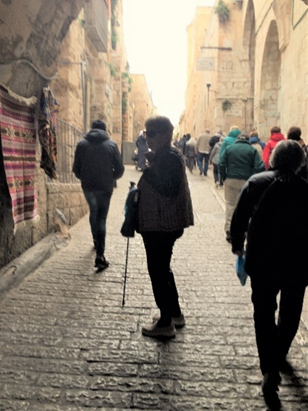
We began our walk through the Stations of the Cross by re-entering the Old City through the Lion’s gate, walking on pavement that Leo said Jesus would have walked.

Leo told us that after the Ottoman invasion, they built the city walls in all the wrong places. They put the Damascus Gate outside of Golgotha and declared that a tomb with a garden outside of it was the Lord’s burial site.
Instead, the actual Golgotha and burial site were now inside the city, because of where they placed the walls. This is why there is confusion about the tomb, he explained, and why some churches believe it’s in the garden outside of the city.
Then we began to walk the Via Dolorosa; as we entered a church on our right, we saw on the corner across from us the sign noting that we’d arrived at the ViDolorosa…our walk had begun.

Station One is where Jesus was condemned to death.

Inside the church we visited the Chapel of the Condemnation, where this image on the wall of the Chapel shows Jesus being condemned by the pharisees. Here, too was the altar of the flagellation…

...and this building also houses the Sanctuary of the Flagellation, where Father held mass.
In this church, too, was an altar to the spot where Jesus was made to carry his cross.

Between Stations One and Two, we went outside and re-entered the building, this time into the hall where the soldiers took Jesus after he was condemned. We walked through what looked almost like ballet bars and sat together on make-shift benches while Leo told us where we were.

The dungeon-like place was called the Lithostrotos. It was here that the soldiers clothed Jesus with purple, then beat Him and spat on him, and forced the crown of thorns onto his head. This place still carried the weight of the evil deeds done here, and the energy in these rooms – especially the darker ones, was heavy enough to make us all uneasy.

Station Two was just ahead and it is marked by the Church of the Sisters of Zion. It is at the point where Jesus was made to carry his cross. An altar to this is also inside of the Sanctuary of the Flagellation… Station two is a convent, where inside is a chapel of an ancient Arch called the Ecco Homo Arch. There was also an altar with a statue showing Jesus carrying His cross, as well as a wall-sized mosaic of the same.
Walking further ahead, moving beneath a high arch and around a corner we came to Station Three, where Jesus fell for the first time. At each station Leo and Father stopped, told us where we were and Father Turner read from the Bible and we said a prayer. We didn’t have time to go inside this chapel, but online it shows an amazing image of Jesus falling…

(Also at each station is a round, metal plaque on the outside of the building, with the station number on it. That was then. Now they have added (or re-added an image of the station itself, like the one you’ll see at station 6, which was on the wall even then.)
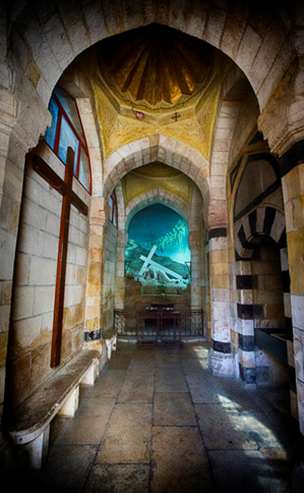

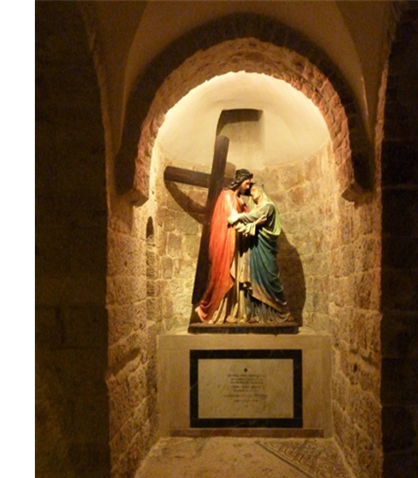
Station Four is so close to Station three that it almost adjoins the third station. (You can see the marker on the right side of the picture of Station three.) It’s marked by another Armenian catholic chapel. This is where Jesus met his mother, and there is a gorgeous statue inside the Chapel, as well as a detailed carving over the entrance door.
Station Five: is where Jesus stumbled and almost fell again, so the soldiers grabbed Simon of Cirene and forced him to carry the cross. It’s marked by a Franciscan Chapel that’s dedicated to Simon and was built over the site of the Franciscans’ first house in Jerusalem (built in 1229). We didn’t go inside this Chapel, but Leo pointed to the corner of the road (people road – no cars) and explained that Simon the Cirenean would have been standing there and that Jesus had been moving uphill when he stumbled on a small step that had been there. (and still was, though not the original one)

While Father Turner was doing the reading at this station, I noticed that, on the far wall of the building – right at the corner – there was a square in the outside wall with something inside it. People who seemed to be going about their everyday business kept pausing there to kiss their fingers, then touch the inside of the square – and then move on. Nearly everyone did it – like it was normal. So, as we headed past it on our way to Station 6, I took a couple of pictures of what looked like an oddly shaped rock that had been framed in the wall. I also kissed my fingers and touched it, too.

Leo was moving very quickly now, so I didn’t stop him to ask. Instead, I looked it up that night online. It turns out that this spot is very famous. It is called “The Handprint”, and it’s the spot where, as Jesus started to fall, he reached out his (left) hand to steady himself. He pressed it against the stone wall, leaving a bloody handprint behind. It’s believed that the shopkeeper protected that spot as long as he lived… and beyond.
. Over the years millions of people have placed their palm over the palm-mark of Jesus, (until doing it was discouraged). Today there is a deep, collective palm print in the rock of the wall. The belief is that, by touching our hands to the same spot that Jesus touched, we show our willingness to stumble and even suffer as He did.
Station Six: Leaving station 5, we walked up several sets of stairs, through small streets crowded with small shops that were open to the street. Here is where Veronica stepped out from the crowd and wiped the face of Jesus as noted by the scene on the wall.


We didn’t go inside the Church of St. Veronica, a Greek-Catholic church, but inside was an altar image depicting the scene. Veronica’s tomb is also inside. As Leo noted, she later found the face of Jesus imprinted on the cloth. In front of us was a partial ancient column, with the statements about Veronica carved into it.
Station Seven: We walked along another street until we came to Station 7, at another Franciscan chapel (actually two). We didn’t go inside this chapel, but it marks the place where Jesus fell a second time. There was a pillar in the middle of the road nearby to mark the exact spot of the second fall. (sorry, I didn’t get the picture…)
Station Eight: After Station Seven, we walked through another crowded street until Father Turner and Leo stopped right below the circular number that marks Station Eight.

Leo told us that this station is the spot where the pious women were crying and Jesus stopped and told them not to weep for him, but for themselves and for their children. There was also a Latin cross carved into the stone next to the square opening that marks the actual spot where Jesus stopped.

After this, we walked through crowded shop-lined streets until we turned a corner and found ourselves once again at the Church of the Holy Sepulcher. And Wow! Now I understood why Leo had insisted that we go early, even though it messed up the Stations for us somewhat. The square in front of the church was full of waiting to get inside!

If we had gone later in the day, after Station 8, we never would have seen all the wonderful and amazing things that are inside that church. It is the holiest place in all of Jerusalem, and it houses Stations nine through fourteen – perfect for Good Friday’s post…
Comments