


Come to Israel

One of the very first people that Jesus appeared to after His resurrection was Mary Magdalene. Mary had bravely made plans to go with a couple other of Jesus’ followers to go to the tomb and finish preparing him for burial, with the proper ointments and spices. The other ladies were very nervous about being stopped – or worse -- by the tomb guards, so Mary just ran ahead of them, bribed the guards at the city gates and arrived at the tomb alone, and finding it empty. She was rewarded for her great love and faith by coming face-to-face with the risen Lord!
Even though it’s believed that Mary was the sister of Lazarus and Martha (yes, that Mary), she’s remembered best for being the scorned woman who’d lived an immoral life in Magdala. (kind of like a female prodigal son…) But today, Magdala is remembered for her!
Magdala was our first stop on the day we visited, and it would quickly become the favorite stop of just about everyone – especially the women.

According to the lady guide who met us at the entrance, Magdala was a first-century town that was considered the “big city” for small towns near them, including Nazareth, which was “only” a day’s walk away. Because of this, quite a few years ago a group of priests decided that this must be where Jesus grew up, and they raised the money to set up a huge dig, hoping to prove that they were right. What they discovered instead was the only synagogue at the Sea of Galilee.
In 2009, a Catholic priest from Spain had a vision of opening a religious retreat center near the highway in ancient Magdala, and he hired professionals, who proceeded with the excavation for it; that’s when the entire town began to be uncovered. They found houses and even a marketplace in the area, as well as an ancient fish-processing facility… Magdala had been a fishing village.
We took pictures of a portion of one street of the village, with the Market structure at the back.

The continuing excavations also revealed a second synagogue. This synagogue is believed to have been built 50 years before the birth of Christ, making it one of the world’s oldest synagogues.

The Migdal stone, original to the synagogue, is a two thousand year old stone that was discovered intact, inside the synagogue during its excavation.

Our guide told us that the archeologists determined that after many of the area temples had been destroyed by the romans, (including the one by the beach) many people from the area came here, to the only synagogue still standing. This was the very synagogue that we were all now sitting in as she spoke.

She told us that everything before us was original, (except the recovered Migdal stone that is now in a museum, replaced by a replica). She told us that the mosaic pattern in the original tile represents eternity.

She explained that the round vessel near the synagogue was for washing your hands before going inside.

Our guide also told us that the dig had been shut down while a retreat center was being built, so as a result, only about 10% of the town had been uncovered at that point.

Each picture of discovered remains that I took represents just a small portion of the houses, streets and rooms that have already been uncovered…
Continuing past the town and toward the water, we went to a church by the water, called Duc in Altum. In the 4th century, Queen Helena had built a church right beside what she believed was the house of Mary Magdalene.
The remains of that church were discovered in the early digs of the 1970’s, but with the dig now closed, we couldn’t even go near enough to see them.
What we saw instead was a church built on the same grounds but right by the water, as a spiritual center to honor women. Consecrated in 2014 by Pope Francis, it was dedicated to the sanctity of women – both today’s women, and all of the women of the bible.

The whole atrium we walked into was in the shape of an octagon and the walls were painted in the same design and colors (peachy and white) as mosaics found on that site, possibly from the earlier synagogue.

We walked into an atrium with 8 pillars, each one representing one of the women who closely followed Jesus: Mary Magdalene; Susana and Johanna, the wife of Chuza; Mary and Martha; Salome, the mother of James and John and wife of Zebedee; Peter’s Mother-in-law; Mary, the wife of Clopas; There was also one pillar dedicated to all the other women who followed Jesus – and the final pillar was for all women who love God.
We all took pictures in front of the pillars.


We all took pictures in front of the pillars.
In the center of the atrium was an unusual baptismal font, covered, and above the rotunda, circular artwork. The main sanctuary was designed to look like and inverted boat. A huge cedar boat (a 1st century replica) stood at the far end of the tabernacle.

Aside from the center altar, there were also four chapels off of the rotunda, two on each side. Behind each altar was a unique, highly detailed and colorful mosaic scene from Jesus’ ministry, done by a Chilean woman:
On one side was a mosaic of Jesus calling Peter and Andrew to discipleship; and another mosaic of Jesus casting out Mary Magdalene’s demons. On the other side was Jesus healing Jairus’ daughter…

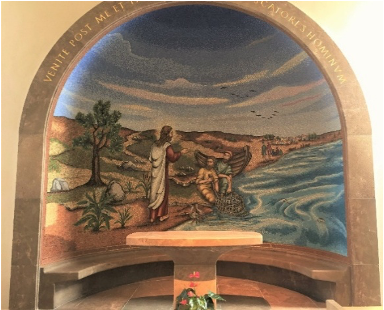

… and one of Jesus walking on water and then pulling Peter up out of the water.
On the far sides of the sanctuary and along the side walls were bigger-than-life-sized icons of each of the apostles (with their names carved into the partial frame above each). Eleven apostles are represented; Judas Iscariot is absent.
Two examples here are Peter, and his brother, Andrew.


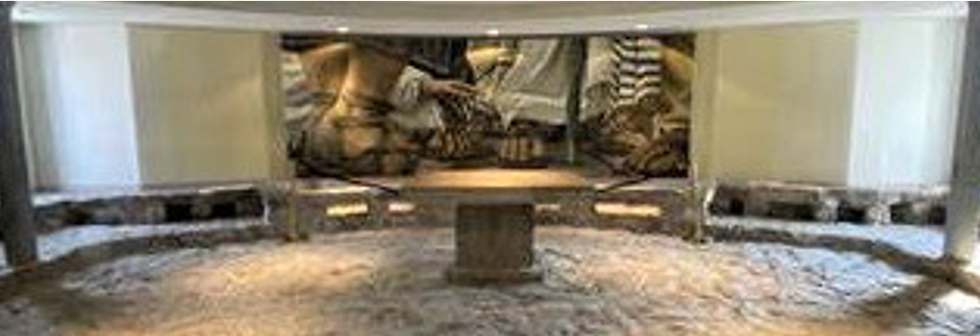
Best of all was a downstairs hall that boasted ancient, paved flooring that, we were told, may have been the courtyard for an early fish market. At its far end was the most stunning altar of all. This last chapel we entered, known as “The Encounter Chapel”, was situated right beneath the main sanctuary upstairs. The stone altar was plain and similar to all the others, but the curved wall behind it held a massive, incredibly life-like painting of “the encounter,” a portrait of the arm of the woman with the twelve-year issue, as she reaches for the hem of Jesus’ robe – through the feet of everyone around him. This picture brought many of us to tears (and most of us bought our own copies for home.)
Finally, we went outside to the beach area, (not everyone went onto the sand – some stayed near the church) where our guide read Psalm 21, as daylight faded into the foggy Sea of Galilee.

The next time we see Jesus appearing to anyone, he’s watching his disciples fishing… Tomorrow we’ll see the very spot where they came in and where Jesus cooked breakfast for them.
Comments